
Portsmouth, NH & the New Hampshire–Southern Maine Seacoast

With economic uncertainty, higher mortgage rates, inflation, and plenty of dramatic housing headlines, it’s understandable that some homeowners and buyers are wondering the same thing:
Is the housing market headed for a crash?
If you live in Portsmouth, along the New Hampshire Seacoast, or in Southern Maine, the current numbers tell a much calmer story.
This isn’t the runaway housing market we experienced a few years ago. Buyers are more selective, homes need to be priced correctly, and some properties are taking longer to sell.
But those conditions don’t add up to a housing crash.
In fact, our local market continues to be supported by something very basic: there are still relatively few homes available compared with the number of people who want to live here.
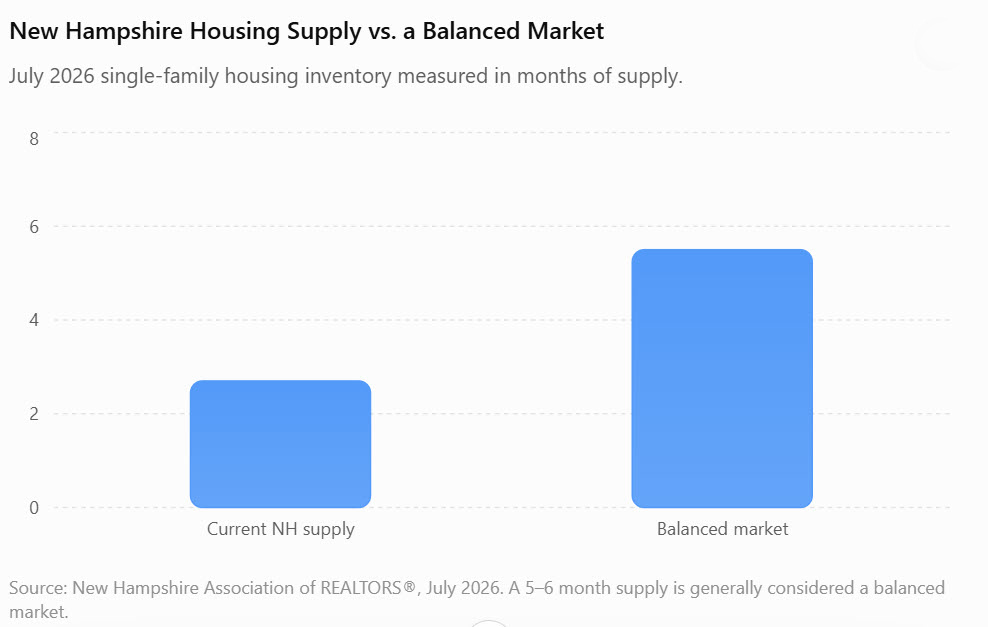
More homes are coming onto the market, but New Hampshire still has only 2.7 months of housing supply – roughly half the 5–6 months generally associated with a balanced market. That’s an important reason today’s market looks very different from a housing crash.
Portsmouth Home Values Remain Strong
One of the clearest signs of the market’s underlying strength is home values.
As of July 31, 2026, Zillow reported the typical Portsmouth home value at approximately $802,763, up 3.3% from a year earlier. Portsmouth homes were going pending in roughly 15 days, although individual results vary considerably by price, location, property type, condition, and how well a home is positioned when it comes on the market.
That doesn’t look like a collapsing housing market. It looks much more like a market that has transitioned from the extraordinary appreciation of the pandemic years into a more moderate environment.
And Portsmouth isn’t alone.
Across New Hampshire, the median single-family sales price reached a record $580,000 in July 2026, according to the New Hampshire Association of REALTORS®. Rockingham County – which includes Portsmouth and much of the Seacoast – had a median sales price of approximately $710,000 this summer.
That’s important perspective for homeowners who may be hearing national stories about falling prices and wondering whether the same thing is happening here.
Real estate is local.

What’s happening in Florida, Texas, Arizona, or another high-inventory market doesn’t necessarily tell you what’s happening in Portsmouth, Rye, New Castle, Hampton, Exeter, Dover, Kittery, York, or Eliot.
More Homes Are Coming on the Market – But We Still Don’t Have an Oversupply
Inventory is one of the most important numbers to watch when people start talking about a housing crash.
A major price decline generally requires some combination of weak demand and an excessive supply of homes for sale.
That’s not what we’re seeing in New Hampshire.
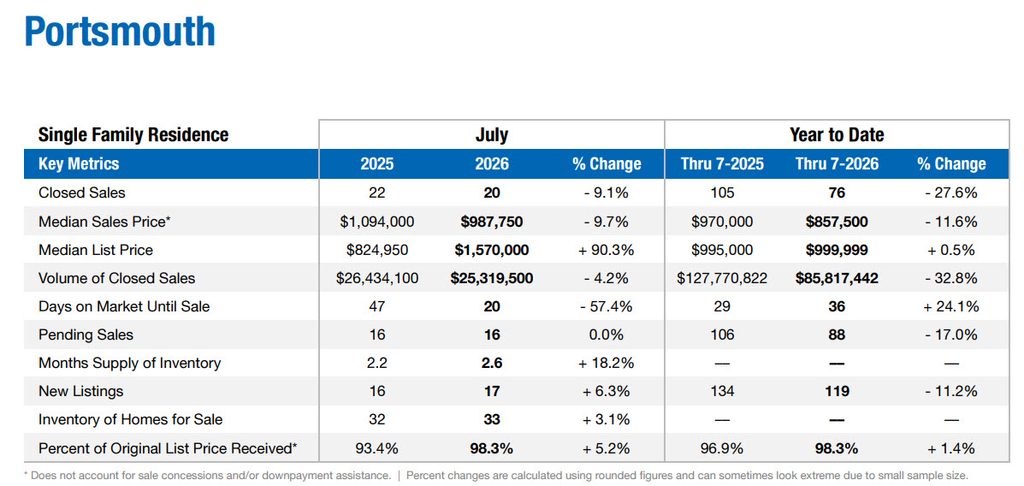
New Hampshire had 2,992 single-family homes available for sale in July, according to NHAR. That’s the highest inventory level since the pandemic and about 16% higher than a year earlier.
That sounds significant – and it is good news for buyers.
But New Hampshire still had only about 2.7 months of housing supply.
A market with roughly five to six months of inventory is generally considered balanced.
So while buyers have more choices than they did during the extreme inventory shortage, we are still a long way from having too many homes for sale.
That distinction matters.
Increasing inventory isn’t necessarily a sign of a weakening market. It can simply mean we’re moving toward a healthier and more balanced one.
Southern Maine Is Showing Similar Stability
The Southern Maine Seacoast is also demonstrating resilience.
In York County, Zillow reported a typical home value of approximately $534,482 as of July 31, up about 1.5% from the previous year.
York itself had a typical home value of approximately $770,142, up 1.9% year over year.
Meanwhile, York County’s median listing price was approximately $649,950 in July.
Those aren’t the dramatic price increases we saw several years ago, but modest appreciation is not necessarily bad news. In many respects, it’s a much healthier environment for buyers and sellers.
Higher Mortgage Rates Changed the Market – They Didn’t Stop It
There’s no question that mortgage rates have changed affordability.
The days of 3% mortgages created purchasing power that today’s buyers simply don’t have. Rates have spent much of the past several years in the 6%-to-7% neighborhood, and that has forced buyers to pay closer attention to monthly payments.
But something else has happened.
Buyers and sellers have adjusted.
People still get married, have children, change jobs, retire, relocate, downsize, inherit property, divorce, buy second homes, and decide they simply want to live somewhere else.
Life continues – and so does the housing market.
Higher rates may change what someone buys or how much they spend, but they don’t eliminate the reasons people move.

Today’s Market Is More Price-Sensitive
This is one of the biggest changes we’re seeing.
During the hottest years of the market, sellers could sometimes price aggressively and still find buyers willing to compete.
That’s much less dependable today.
Buyers have access to more information, affordability matters more, and properties that don’t appear to offer good value can sit on the market.
In Portsmouth, for example, Zillow’s June data showed a median sale-to-list ratio of approximately 99.4%. About 31% of sales were above asking price, while roughly 43% sold below asking.
That’s an excellent illustration of today’s market.
Some properties still generate competition.
Others require negotiation.
Pricing, preparation, presentation, marketing, and local knowledge matter again.

Why Today’s Market Is Different from 2008
When people hear “housing crash,” they’re often thinking about 2008.
But today’s housing market is fundamentally different.
The 2008 crisis involved excessive construction, risky lending practices, highly leveraged homeowners, widespread foreclosures, and a tremendous amount of distressed inventory entering the market.
Today’s homeowners generally have considerably more equity, lending standards are stronger, and here on the Seacoast we continue to deal with a limited housing supply.
Could home prices fluctuate? Absolutely.
Could some individual properties sell for less than owners expect? Certainly.
Could economic conditions slow sales?
Yes.
But a normal market correction, slower appreciation, or longer marketing times should not automatically be confused with a housing crash.
What This Means for Portsmouth and Seacoast Sellers
If you’re considering selling, don’t assume you missed your opportunity because the frantic pandemic-era market has passed.
There are still serious buyers looking for homes throughout Portsmouth and the surrounding Seacoast.
But today’s market rewards sellers who get the fundamentals right:
Price accurately. Prepare the home properly. Present it professionally. Market it aggressively. And have a strategy before the property goes on the market.
The first few weeks of a listing remain extremely important. Starting too high and reducing the price repeatedly can ultimately produce a worse result than pricing intelligently from the beginning.

Get a free copy of our 52 page eBook titled “450 Ideas To Help Your Home Sell Faster!”
What This Means for Buyers
Buyers finally have something they haven’t had much of in recent years:
A little more breathing room.
You may have more homes to consider, fewer bidding wars on certain properties, and more opportunities to negotiate inspections, closing dates, financing terms, or price.
But don’t mistake a more balanced market for a market where every seller is desperate.
Well-priced homes in desirable Seacoast locations can still move quickly.
The key is knowing where you have leverage – and where you don’t.
Get a free copy of our buyer’s guide, “There’s No Place Like Home“, to help guide you on your journey.

Local Experience Matters More in a Changing Market
National housing statistics can provide useful context, but they won’t tell you what a condominium in downtown Portsmouth is worth compared with a home in Little Harbor, a waterfront property in Rye, a house in New Castle, or a property just across the Piscataqua River in Kittery.
That’s where local market knowledge becomes particularly valuable.
Ann Cummings and Jim Lee of RE/MAX Shoreline bring decades of real estate experience to buyers and sellers throughout Portsmouth, the New Hampshire Seacoast, and Southern Maine.
Both Ann and Jim have served as President of the New Hampshire Association of REALTORS®, and both have been recognized as New Hampshire REALTOR® of the Year.
Their experience includes changing markets, strong seller’s markets, buyer’s markets, periods of high and low interest rates, recessions, housing booms, and housing corrections.

That long-term perspective matters.
Real estate decisions shouldn’t be based on frightening national headlines. They should be based on current local market conditions, comparable sales, inventory, buyer demand, property condition, location, and your individual goals.
The Bottom Line
The Portsmouth and Seacoast housing market has changed.
But change and crash are not the same thing.
Inventory has improved, buyers have become more selective, and mortgage rates have changed affordability. At the same time, Portsmouth and the surrounding New Hampshire and Southern Maine Seacoast continue to benefit from limited housing supply and strong demand for one of New England’s most desirable places to live.
For sellers, that means opportunities remain – but pricing and marketing matter.
For buyers, it means there may finally be more choices and negotiating opportunities – but desirable properties can still attract competition.
If you’ve been waiting on the sidelines because you’re worried about a housing crash, it may be worth looking past the headlines and examining what’s actually happening in your local market.
Ann Cummings & Jim Lee, REALTORS®
RE/MAX Shoreline
Serving Portsmouth, the New Hampshire Seacoast & Southern Maine
NewHampshireMaineRealEstate.com
Frequently Asked Questions About the Portsmouth & Seacoast Housing Market
1. Is the Portsmouth, NH housing market going to crash?
Current data doesn’t indicate a 2008-style housing crash. Portsmouth and the broader Seacoast continue to have relatively limited inventory and strong underlying demand. Markets can change, but today’s conditions are very different from those preceding the 2008 housing crisis.
2. Are Portsmouth home prices falling?
Not overall based on the latest data. Zillow’s July 2026 data put the typical Portsmouth home value at approximately $802,763, about 3.3% higher than a year earlier. Individual neighborhoods and property types can perform differently, however.
3. Is 2026 a good time to sell a home in Portsmouth?
It can be. Inventory remains relatively constrained, but buyers are more price-conscious than they were several years ago. Sellers who price appropriately and present and market their homes well can still be in a strong position.
4. Should I wait until mortgage rates fall before buying?
Not necessarily. Lower rates could improve affordability, but they could also bring additional buyers into the market and increase competition. The better question is whether buying makes financial and personal sense for you at today’s price, payment, and market conditions.
5. Are buyers able to negotiate again?
Yes, in many situations. Some properties are selling below asking price, and buyers may have opportunities to negotiate price, inspections, closing dates, and other terms. Highly desirable and correctly priced homes can still attract multiple buyers.
6. Is Southern Maine still a strong housing market?
Southern Maine, particularly York County and communities such as Kittery, Eliot, York, and South Berwick, continues to attract buyers. York County home values were approximately 1.5% higher year over year as of July 2026 according to Zillow.
7. What is my Portsmouth or Seacoast home worth in today’s market?
The best way to determine market value is through a detailed comparative market analysis using recent sales, current competition, location, condition, improvements, lot characteristics, and current buyer demand. Automated online estimates can be useful starting points, but they don’t replace a property-specific analysis.
8. Should I price my home high so I have room to negotiate?
Usually that’s not the best strategy. Today’s buyers can compare properties and recent sales quickly. An overpriced home may receive less attention during the critical first weeks on the market. Strategic pricing can often create stronger interest and a better negotiating position.
9. Why work with an experienced local REALTOR® instead of relying on national housing information?
Because housing markets can vary dramatically from one town – and even one neighborhood – to another. Portsmouth, Rye, New Castle, Hampton, Dover, Exeter, Kittery, and York don’t necessarily move in lockstep. Experienced local REALTORS® can interpret the sales and inventory data in the context of the specific property and neighborhood.
10. Who can help me understand whether I should buy or sell now?
Ann Cummings and Jim Lee of RE/MAX Shoreline work with buyers and sellers throughout Portsmouth, the New Hampshire Seacoast, and Southern Maine. With decades of experience and extensive involvement in the New Hampshire real estate profession, they can help you evaluate your options based on current local conditions rather than national headlines.
Thinking about buying or selling? Start with a conversation about your goals, your property, and what today’s Seacoast market actually means for you.